Introducing code-adapt: A CLI for the Adaptation Lifecycle
You maintain a project that depends on an upstream repository. A new security patch lands. Three PRs get merged. A release ships. You find out two weeks later, buried in a changelog you forgot to check.
This is the problem code-adapt solves.
The Adaptation Lifecycle
Most teams handle upstream tracking informally — someone glances at a repo, maybe sets up a GitHub notification, and then manually figures out what changed and whether it matters. That works until it doesn’t.
code-adapt introduces a structured lifecycle:
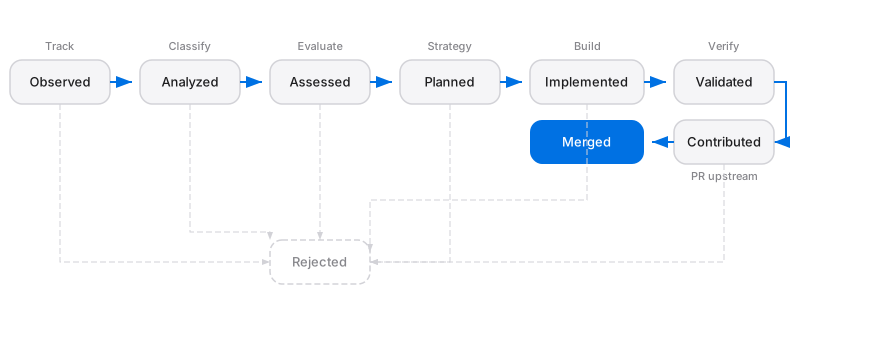
Each stage has a clear purpose, and the CLI guides you through every transition. The state machine is enforced in code — you can’t skip stages or make invalid transitions.
How It Works
1. Observe
Track what happened upstream — commits, pull requests, releases:
cadp observe my-upstream --since 7d
This fetches all changes from the last week and stores them locally as observations. No more manually browsing GitHub.
2. Analyze & Assess
Each change gets classified automatically — is it a security fix, a bugfix, a refactor, or a new feature? Then code-adapt evaluates relevance against your project’s profile and policies:
cadp analyze pr-451
cadp assess pr-451 --against my-project
The assessment considers which modules are affected, how risky the change is, and suggests an action: adopt, adapt partially, monitor, or ignore.
3. Plan & Implement
For changes worth adopting, generate an adaptation plan with a concrete strategy:
cadp plan adaptation-001
cadp implement adaptation-001 --branch --open-pr
This creates the implementation branch, stubs out the files that need changes, and can even open a draft PR.
4. Learn
After each adaptation, record the outcome. Over time, code-adapt builds a feedback loop that makes future assessments more accurate:
cadp learn adaptation-001 --outcome success
What’s Under the Hood
code-adapt is built in Python with a few deliberate technical choices:
- Pydantic v2 models enforce the state machine — you can’t skip stages or make invalid transitions
- Atomic file writes (temp + rename) prevent corrupted state
- All state lives in
.adapt/as YAML and JSON files, tracked in git — no external database, no server - Dual output — every command produces rich terminal output for humans and
--jsonfor scripts and CI
Install
pip install code-adapt
Or use the short alias:
cadp --help
Requires Python 3.11+ and a GitHub token (gh auth login or GITHUB_TOKEN env var).
What’s Next
This is v0.1.0 — the foundation. The lifecycle engine, classification, and assessment logic are solid. Coming next:
- Smarter assessment using downstream dependency graphs
- Batch observation across multiple upstreams
- Integration with code-explore for cross-project impact analysis
The source is on GitHub. Feedback, issues, and contributions are welcome.